The music
A live machine
Six tribe tracks played back to back at 160 BPM, in Ableton Live.
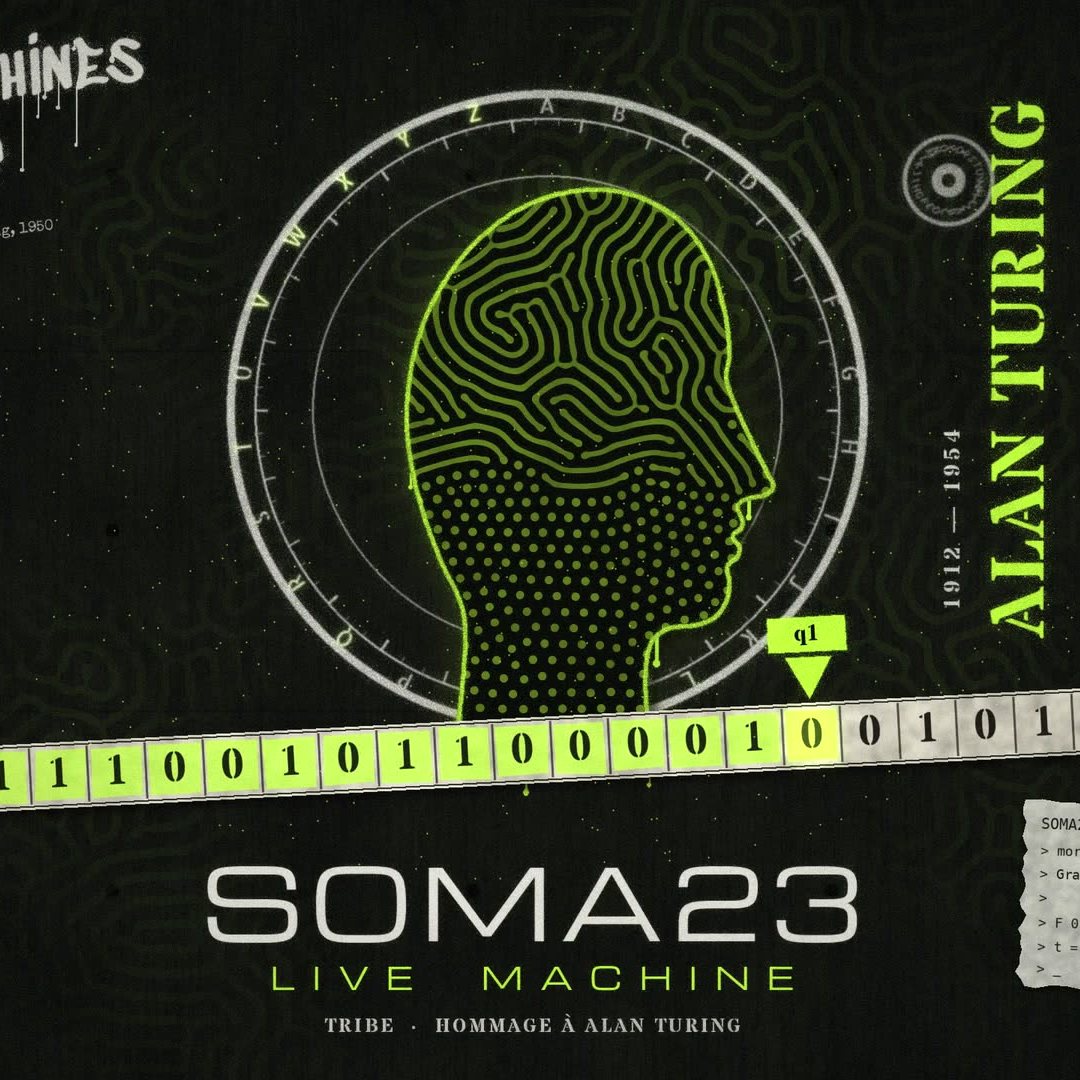
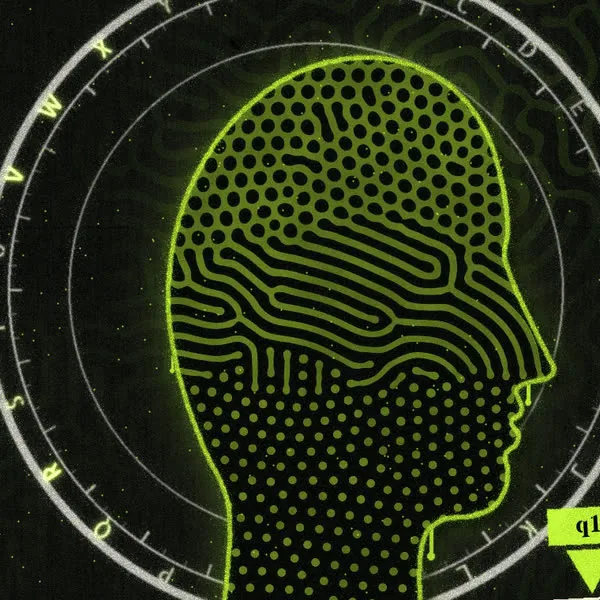
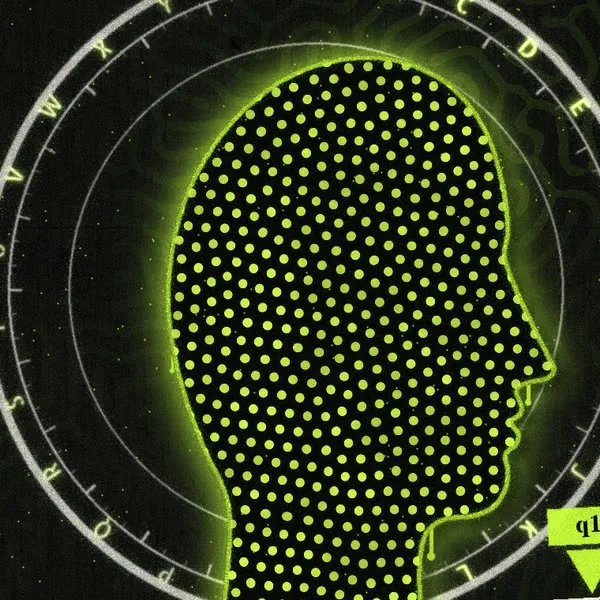
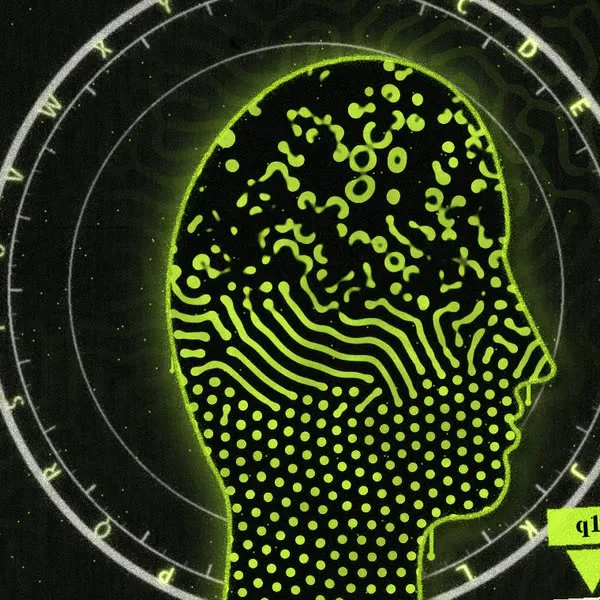
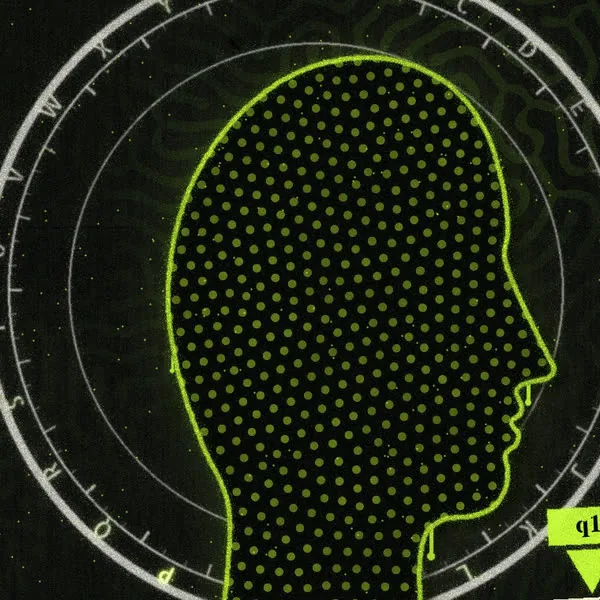
36 minutes of tribe tekno at 160 BPM, played in Ableton Live, as a tribute to Alan Turing (1912 – 1954). The pattern inside the head is a real Gray-Scott reaction-diffusion simulation, the model behind “Turing patterns”, computed frame by frame and driven by the music: the machine draws its own shapes.
Six tribe tracks played back to back at 160 BPM, in Ableton Live.
Two substances reacting and diffusing on a grid: a reaction-diffusion model, recomputed every frame.
A different pattern for each of the six tracks, the bass that keeps it alive, the breaks that switch it off.
In the centre, a head in profile: that is where the simulation grows. Around it, the alphabet of the Bletchley Park Bombe — the machine designed by Turing and Gordon Welchman to break Enigma — lights up like a spectrum analyser, and its drums turn in time with the tempo.
At the bottom, the tape of the Turing machine moves one cell per bar, under the read head. On the left, “Can machines think?”, the question that opens his 1950 paper, and an “On Computable Numbers” (1936) card with the table of a two-state Turing machine.
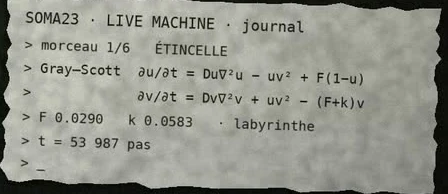
On the right, the machine's log: the current track, the equations, the F and k settings, the name of the pattern and the number of computation steps since the start — over half a million by the end.
In 1952, in “The Chemical Basis of Morphogenesis”, Alan Turing showed that two substances that react with each other and diffuse at different speeds can, starting from an almost uniform mixture, produce regular patterns all by themselves, such as spots or stripes. These have been called Turing patterns ever since.
The Gray-Scott model (Peter Gray and Stephen K. Scott, 1980s) is one of the simplest versions to compute. Two substances: U, the food, and V, which reproduces by consuming it (U + 2V → 3V). U is fed in continuously at rate F; V is removed at rate F + k:
∇²: diffusion (each point mixes with its neighbours) · uv²: the reaction · F (1 − u): the food supply · (F + k) v: the removal of V.
Depending on F and k, the same system gives mazes, spots that divide like cells, holes, worms… In 1993, physicist John E. Pearson mapped them out. The live wanders across that map: one setting per track.
F and k as shown in the video's log, and the name of the pattern. k rises at times (from 0.0570 up to 0.0592 read in Étincelle): the higher it is, the faster V disappears. Click a track to jump to it.
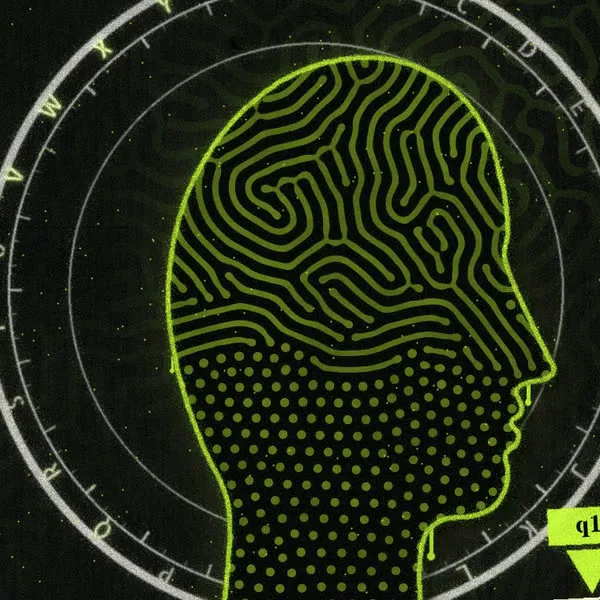
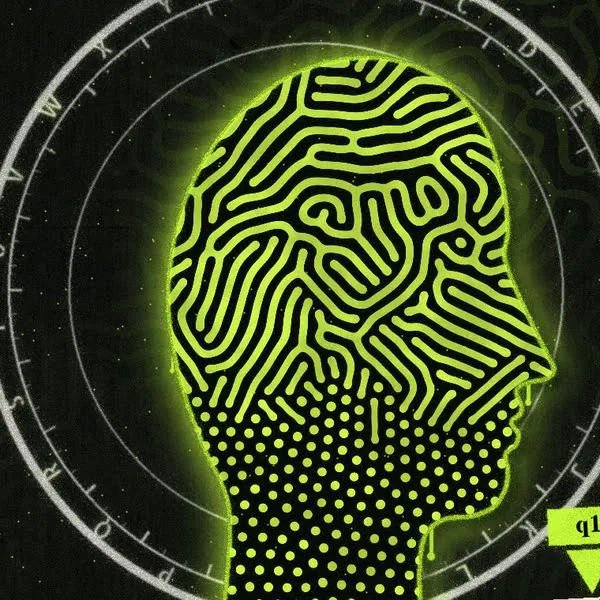
Mathematician and pioneer of computing and artificial intelligence, Alan Turing (1912 – 1954) was also one of the first to ask how living matter makes its shapes. This live sets both halves of his work to music: the machine and the pattern.