Lorenz Storm Live
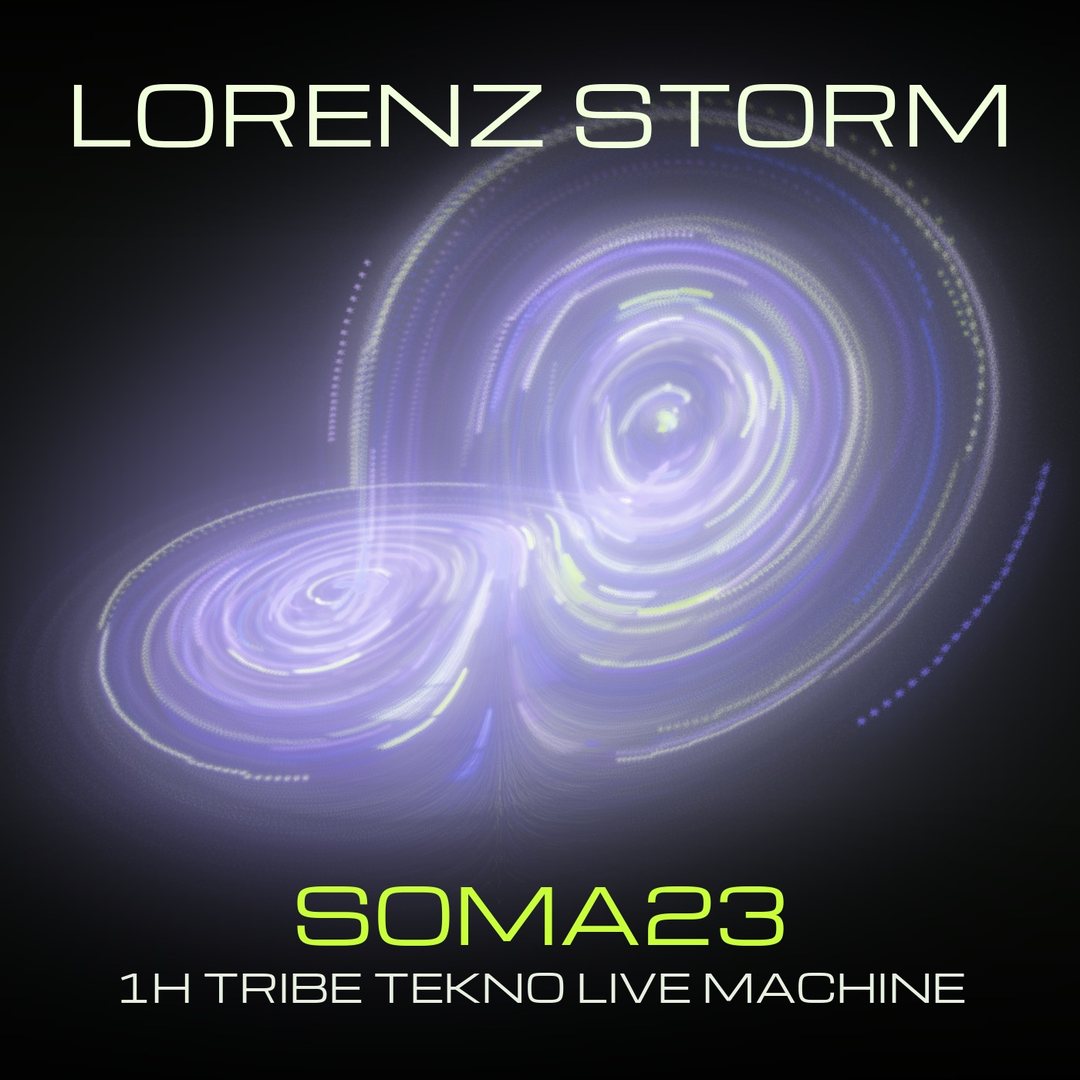
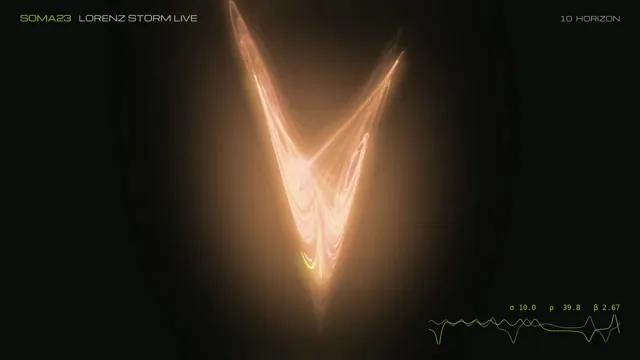
An hour of tribe tekno at 163 BPM, played in Ableton Live. The image is a real simulation of the Lorenz system, the model of atmospheric convection with which meteorologist Edward N. Lorenz discovered chaos in 1963: the butterfly effect. 86,400 particles, computed frame by frame and driven by the music.
A storm of particles, driven by the music
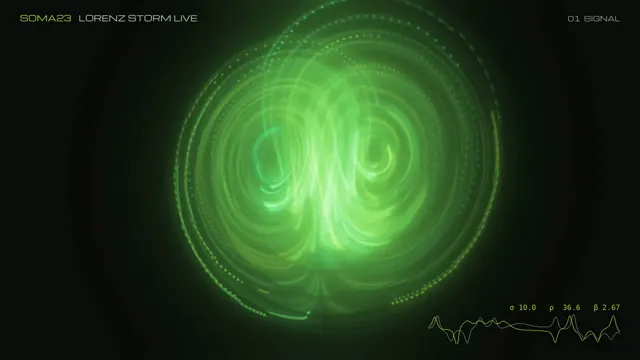
Each point of light is a particle released into the Lorenz system: 86,400 of them, recomputed every frame. The music drives them. Every kick sends off tight clusters that chaos stretches into ribbons, the bass opens the butterfly's wings, the breaks let the storm fall back into its two eyes and the drops blow everything apart.
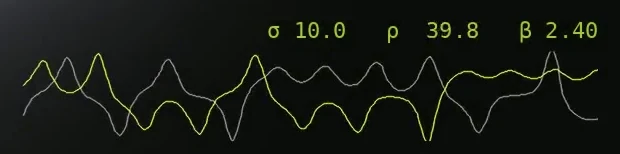
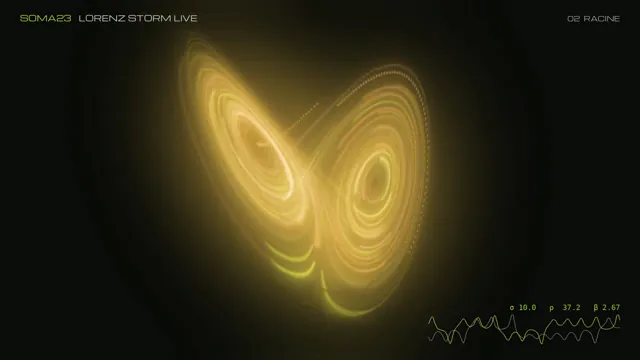
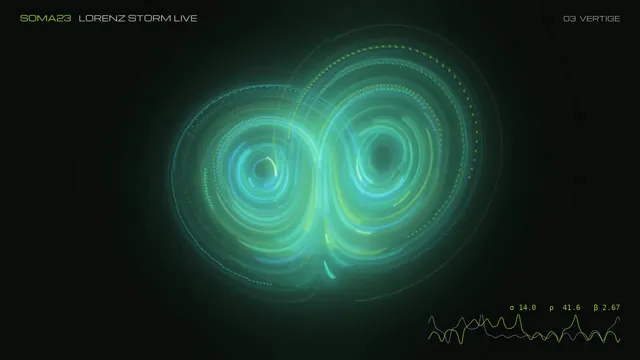
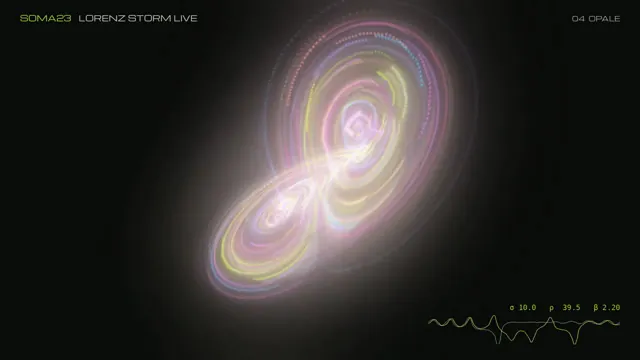
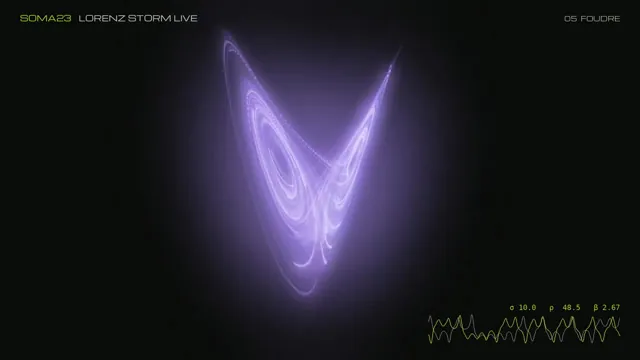
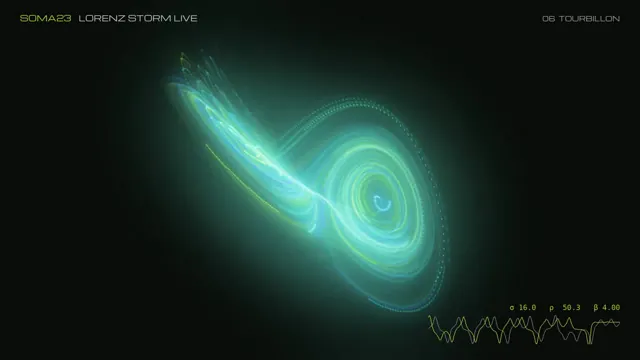
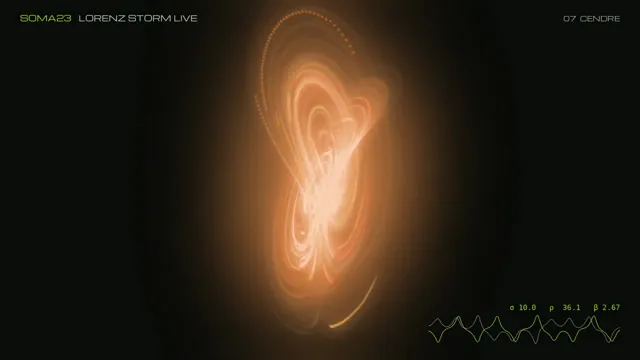
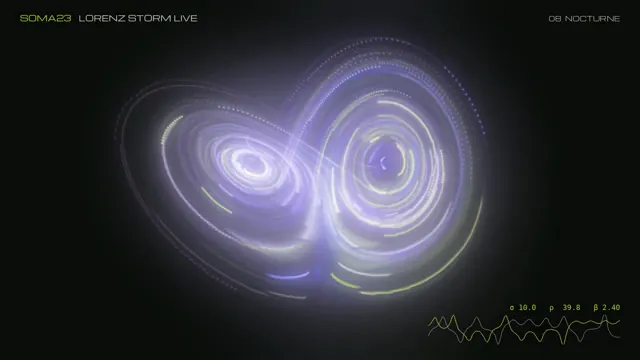
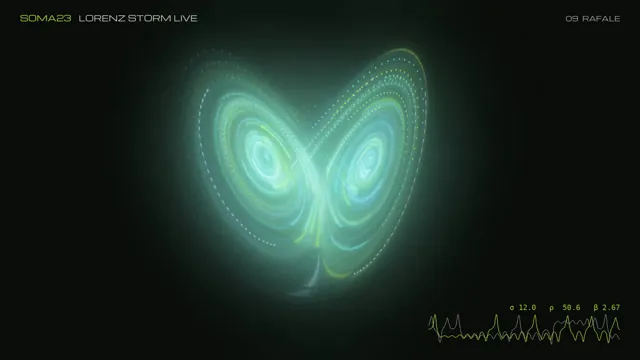
Each of the ten parts has its own settings and its own colour. Bottom right, the values of σ, ρ and β are shown above two curves: two trajectories that started 0.0001 apart. The same system, two stories.
The Lorenz system
In 1963, in “Deterministic Nonperiodic Flow”, Edward N. Lorenz boiled convection — air heated from below that rises, cools and sinks again — down to three equations:
x: strength of the convection (its sign gives the direction of rotation) · y: temperature difference between rising and sinking air · z: distortion of the temperature profile.
σ depends on the fluid, β on the geometry, ρ on how hard the fluid is heated. With Lorenz's values (σ = 10, β = 8/3, ρ = 28), the trajectory never repeats and never stops: it circles two centres, jumps from one to the other without warning and traces the butterfly-shaped figure known as the Lorenz attractor.
Two almost identical starting points end up on unrelated paths: sensitivity to initial conditions. In 1972, a talk by Lorenz gave it a title that stuck: “Does the flap of a butterfly's wings in Brazil set off a tornado in Texas?”
It all comes down to ρ
Below a threshold — about 24 with Lorenz's values, a little more or less depending on σ and β — the system always ends up settling on one of the two centres: convection becomes steady, and the particles spiral in and come to rest in the two eyes. Above it, nothing settles: that is chaos.
In the live, σ and β change from one part to the next, and ρ follows the music. In our readings of the image, it drops below the threshold during the breaks; elsewhere, the values read range from 33.4 to 62.9.
Ten tracks, ten colours
One colour and one set of parameters per part (σ and β, read off the image), and the build-up that leads to the drop. Click a part to jump to it.
A one-hour live machine
Ten tribe tekno tracks played back to back, all in G, at 163 BPM, in Ableton Live. Four of the changeovers are blends; the others go through a bridging break, an ambient bridge or a hard cut.
Vertige and Tourbillon have two drops each. At the end, the kick stops eight bars before the last one: only the percussion and the chorus remain, in the echo.
- Length
- 1 h 01 min 41 s
- Tempo
- 163 BPM, in G
- Style
- Tribe tekno, live machine
- Picture
- 1920 × 1080, 30 frames per second
- Sound
- AAC stereo, 44.1 kHz
- Simulation
- Lorenz system, 86,400 particles
- Parts
- 10
- Played in
- Ableton Live